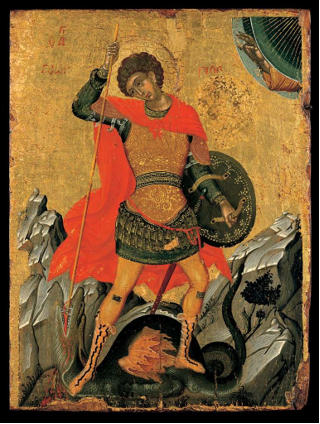
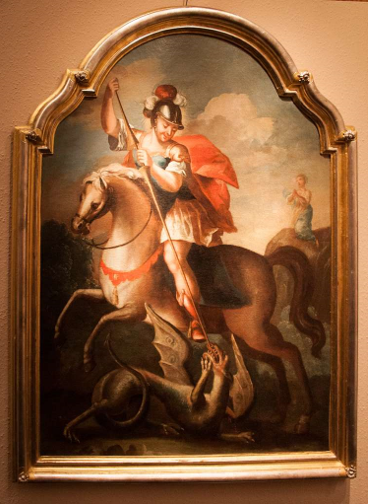
Although Saint George never visited England, he has been the Patron Saint of England since the 1340s. He was born in Cappadocia (modern-day Türkiye) and served with distinction, likely as an officer of the Roman Army. However, after becoming a Christian and declaring his new faith in front of the Roman Emperor, he was immediately sentenced to death, making him a martyr. He was killed and entombed in the town of Diospolis or Lydda in Palestine(now Lod in Israel) in around the year 303.
Wasn’t he a Knight?
Although Saint George is often depicted as a knight, it wasn’t until the 11th Century that he was depicted as the Knight in shining armour who slayed a dragon. Saint George was popular with many English kings, most notably Edward I (1272 – 1307), who had banners bearing the St. George’s Cross and Edward III (1327 – 1377), who had such a strong interest in Saint George, that he owned a relic of his blood. However, it wasn’t until the 16th Century that Saint George’s cross would become England’s national flag.
The story of George and the Dragon is that a Dragon, who had a taste for humans, terrorised Silene (modern-day Libya), but was appeased by sacrificial offerings. They started off by sacrificing sheep, but eventually changed to humans, who were picked as part of a lottery. One day, the King’s daughter was picked to be sacrificed. However, Saint George arrived just in time to courageously slay the dragon, saving the King’s daughter. This story was developed and popularised in the Middle Ages as part of a compendium of stories about the lives of the Saints, called The Golden Legend.
Much like the snakes in the story of Saint Patrick, The Dragon is likely symbolism, representing paganism, heresy, Christian prosecution or possibly even the Devil himself. Although it is unlikely that Saint George actually killed a dragon, he was killed for being openly a Christian.
What other countries celebrate Saint George?
England is not the only country to have Saint George as their patron saint! He is truly an international saint, being celebrated in:
· England
· Georgia
· Ethiopia
· Portugal
· Lithuania
· Catalonia (Spain)
· Aragon (Spain)
· Palestine
· Moscow (Russia)
· Beirut (Lebanon).
We use cookies on our website to give you the most relevant experience by remembering your preferences and repeat visits. By clicking “Accept All”, you consent to the use of ALL the cookies. However, you may visit "Cookie Settings" to provide a controlled consent.
This website uses cookies to improve your experience while you navigate through the website. Out of these, the cookies that are categorized as necessary are stored on your browser as they are essential for the working of basic functionalities of the website. We also use third-party cookies that help us analyze and understand how you use this website. These cookies will be stored in your browser only with your consent. You also have the option to opt-out of these cookies. But opting out of some of these cookies may affect your browsing experience.
Necessary cookies are absolutely essential for the website to function properly. These cookies ensure basic functionalities and security features of the website, anonymously.
Cookie
Duration
Description
cookielawinfo-checkbox-analytics
11 months
This cookie is set by GDPR Cookie Consent plugin. The cookie is used to store the user consent for the cookies in the category "Analytics".
cookielawinfo-checkbox-functional
11 months
The cookie is set by GDPR cookie consent to record the user consent for the cookies in the category "Functional".
cookielawinfo-checkbox-necessary
11 months
This cookie is set by GDPR Cookie Consent plugin. The cookies is used to store the user consent for the cookies in the category "Necessary".
cookielawinfo-checkbox-others
11 months
This cookie is set by GDPR Cookie Consent plugin. The cookie is used to store the user consent for the cookies in the category "Other.
cookielawinfo-checkbox-performance
11 months
This cookie is set by GDPR Cookie Consent plugin. The cookie is used to store the user consent for the cookies in the category "Performance".
viewed_cookie_policy
11 months
The cookie is set by the GDPR Cookie Consent plugin and is used to store whether or not user has consented to the use of cookies. It does not store any personal data.
Functional cookies help to perform certain functionalities like sharing the content of the website on social media platforms, collect feedbacks, and other third-party features.
Performance cookies are used to understand and analyze the key performance indexes of the website which helps in delivering a better user experience for the visitors.
Analytical cookies are used to understand how visitors interact with the website. These cookies help provide information on metrics the number of visitors, bounce rate, traffic source, etc.
Advertisement cookies are used to provide visitors with relevant ads and marketing campaigns. These cookies track visitors across websites and collect information to provide customized ads.